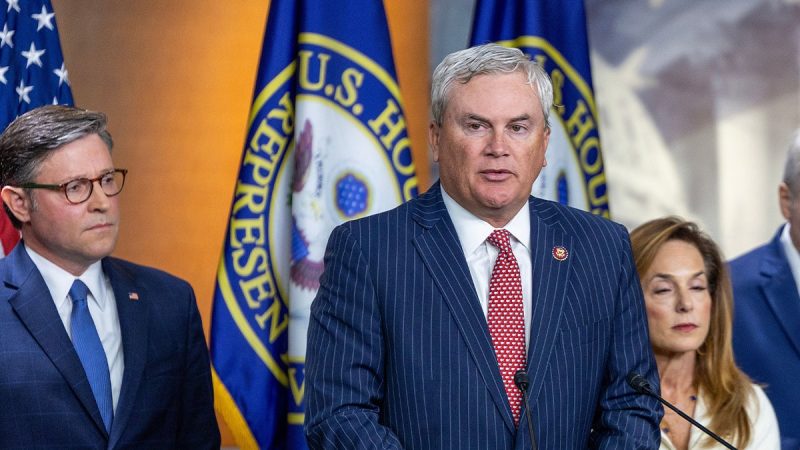
Lawmakers on Capitol Hill have unveiled a new spending bill totaling at least $174 billion that could get a vote in the House of Representatives as early as this week.
It’s a significant step toward avoiding another government shutdown come Jan. 30, the deadline congressional leaders set after ending the recent 43-day shutdown — the longest in U.S. history — in November.
The legislation released on Monday is a package of three of the 12 annual spending bills that Congress is charged with passing: commerce, justice, science and related agencies; energy and water development and related agencies; and interior, environment and related agencies.
Senior Republicans and Democrats both signaled support for the bill, which was expected after it was created as the result of bipartisan discussions between the Senate and House Appropriations Committees.
‘This bipartisan, bicameral package reflects steady progress toward completing FY26 funding responsibly. It invests in priorities crucial to the American people: making our communities safer, supporting affordable and reliable energy, and responsibly managing vital resources,’ House Appropriations Committee Chairman Tom Cole, R-Okla., said in a statement. ‘It also delivers critical community projects nationwide, along with investments in water infrastructure, ports, and flood control that protect localities and keep commerce moving.’
Rep. Rosa DeLauro, D-Conn., the top Democrat on the panel, said the bill ‘is a forceful rejection of draconian cuts to public services proposed by the Trump Administration and Republicans in Congress’ that is free of what she called ‘Republican poison pill’ provisions.
House Speaker Mike Johnson, R-La., said its release is a step toward avoiding a ‘bloated omnibus bill’ and would ‘spend less than another continuing resolution’ in an apparent bid to ease conservative fiscal hawks’ concerns.
Two of those fiscal hawks, Reps. Chip Roy, R-Texas, and Ralph Norman, R-S.C., sit on the House Rules Committee, the panel that acts as the final gatekeeper before most legislation gets a House-wide vote. It’s not immediately clear whether they will support the bill.
In a sign of potential support from conservatives, however, House Freedom Caucus Chairman Andy Harris, R-Md., told Fox News Digital of the legislation, ‘We are still going through this minibus — but it appears to be in line with keeping this year’s discretionary spending below last year’s level — which is a good first step to actually lowering spending next year to control our runaway federal debt.’
The House Rules Committee is meeting to advance the legislation on Tuesday evening, with a final vote likely on Thursday. A subsequent procedural vote in the House, called a ‘rule vote,’ will need support from nearly all GOP lawmakers in order to advance.
The largest chunk of funding is aimed at the Commerce and Justice Departments, as well as related agencies. It provides roughly $78 billion in funding for NASA, the FBI, the U.S. Marshals Service and the Bureau of Prisons, among other areas.
Coming in second is the energy funding bill, which would devote just over $58 billion in funding largely to the Department of Energy. Notably, the bill beefs up nuclear defense and energy production funding, allocating roughly $25 billion to the National Nuclear Security Administration. A large chunk of that funding would be directed toward nuclear weapons activities and stockpile modernization.
Rounding out the trio is the interior funding bill, which would provide over $38 billion in funding spread across the Interior Department, Environmental Protection Agency, U.S. Forest Service and other related agencies.
Notably, the package includes just over $3 billion in ‘Community Project Funding,’ also known as earmarks, which lawmakers request for specific initiatives on their home turf.
While the last shutdown originated in the Senate, it appears that Senate Democrats are willing to play nice with Republicans ahead of the deadline.
Senate Minority Leader Chuck Schumer, D-N.Y., said ahead of Congress’ holiday break that Democrats’ goal was to complete the remaining slate of funding bills by the Jan. 30 deadline and noted that ‘we want to get through the process.’
Given that the latest package is a bicameral, bipartisan product, Senate Democrats are likely to support it.
Advancing the package in the Senate would go a long way toward funding the government but still falls short of the entire list of a dozen bills needed to fund the government. And there are still some more difficult spending bills lurking in the background, like defense, which Democrats rejected during the shutdown.
Sen. Patty Murray, D-Wash., and the top-ranking Democrat on the Senate Appropriations Committee, touted in a statement that the funding package put Congress back into the driver’s seat of funding the government, taking the keys from President Donald Trump and Office of Management and Budget Director Russ Vought.
‘Importantly, passing these bills will help ensure that Congress, not President Trump and Russ Vought, decides how taxpayer dollars are spent — by once again providing hundreds of detailed spending directives and reasserting congressional control over these incredibly important spending decisions,’ Murray said.
If the legislation passes both the House and Senate, Congress will have advanced six of its 12 spending bills. It’s worth noting that another shutdown would only affect the agencies and offices left unfunded at the time of its beginning.